“There’s a million-seller book and you go to the store and you buy it, you get it home and you open it up and you go, ‘Hold it. I already know all these words.’ And music is the same way. If you play a G chord and a C chord and a D chord, you’ve played all the notes in the G scale and you already know them, so come on!” - Alan Munde
Keith Billik here with the Picky Fingers Banjo Podcast, thank you so much for joining me for the first ever replay episode. And there’s a few reasons I’m doing this, not the least of which has been I’m really busy right now — and it’s all good, I’m not trying to get sympathy or anything, but I’ve been doing stuff like I actually just got off of the video call for our monthly VIP lounge where I have a video chat with all of my lovely, intelligent Patreon supporters, and that’s always a great time seeing all of you there. And that reminds me, we have a Patreon supporter of the show to thank, and that today is Nathan Lasikas. Nathan is a Hall of Honor patron, which is the highest honor bestowed upon a civilian podcast listener. He’s originally from Buffalo, New York, but now is picking up a storm over in Denver, Colorado. So if you’re in that area and you run into Nathan, tell him hi for me and tell him thank you for supporting the Picky Fingers podcast. It really does help and I really do appreciate it. To become a supporter of the show yourself, head on over to patreon.com/banjopodcast, and for just a few dollars a month you can become an official supporter of the show. You can get invited to those VIP (very important picker) video meetups and all sorts of other prizes, along with the satisfaction of knowing that you are helping keep the top banjo podcast in the world pumping through those earbuds or however you’re listening to it right now — in the car, whatever. We want to keep it coming folks, so thank you so much for everyone’s support. Once again, that’s patreon.com/banjopodcast.
Now I mentioned that I’m busy with a lot of things, and that is one reason why I’m choosing to replay an episode. I am actually preparing for a few things right now, such as this weekend I will be running sound over at Midwest Banjo Camp, which if you head over to midwestbanjocamp.com you will see the very impressive list of instructors. I will be there, so if you happen to be there come say hi, and if you ask nicely I’ll probably even have a Picky Fingers official sticker for you. And even though this episode is a replay, I am planning all sorts of very cool interviews coming up in the near future, and I’m not going to spoil it, but I can’t wait to have you hear them, so stay tuned for that.
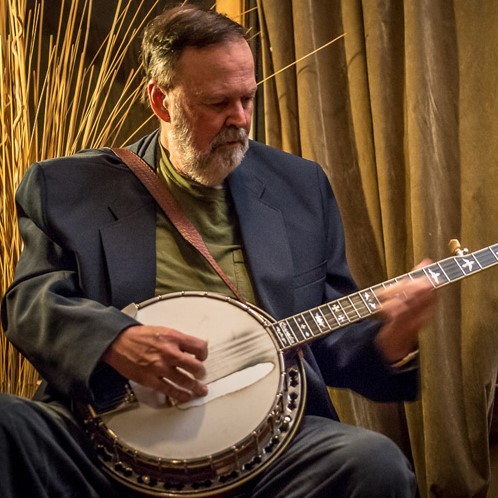
Today’s featured guest is the great Alan Munde. So I keep mentioning that this is a replay episode — and what do I mean by that? This is actually a compilation of episodes six and seven, which aired — or rather, I actually did the interviews — about five years ago now, and the subject of the interview is Alan Munde. So there’s a lot of things happening here. For one thing, Alan is one of my all-time favorite players, so I always love a chance to re-put out there his stories and some of the advice that you can hear in his own words, which is really, really great, and I really loved revisiting this. Another thing is, this was kind of a big deal to me when I was initially doing this podcast. Alan was kind of the first big-name player that I was able to secure as far as being a guest on the show, and that really gave me and this show quite a bit of credibility going forward, and I think without people like him, who initially said yes to interviews with some guy who they didn’t know, I probably wouldn’t be here right now doing this episode. So I’m a huge fan of Alan’s — he has meant a lot to me as a player and a lot to me in terms of building the Picky Fingers Banjo Podcast, and what better way to express that than putting this back out into the world for you all to discover for the first time, or perhaps rediscover as I am doing. So here we go — give a warm Picky Fingers welcome to the great Alan Munde.
I’m from Norman, Oklahoma, and I’ve got two older brothers and a younger sister. Early on, my oldest brother played the accordion for a length of time, and then my younger sister got into it — and this is back in the day when the teacher would actually come to the house.
The door-to-door salesman, yeah.
Right. And she was a college student, the teacher was. Nancy Carter was her name, and she was the former either runner-up or Miss Oklahoma or something, but she would come over and give my sister lessons, and then after my sister took a lesson she would show me what she learned, so I would kind of fool around on the accordion some. So I had this interest in music, and my parents had recordings around the house — and this is back in the day when an album was a collection of several 78s.
More of a compilation style.
You would have Beethoven’s Ninth Symphony or something, and it would take six 78s or more probably to do something like that. So we had those, and I would listen to Strauss waltzes and those sorts of things, and maybe a recording of a musical — My Fair Lady or some such. And then my oldest brother came home from the Navy with a guitar and a record on how to play it, Pete Seeger’s Folk Singer’s Guitar Guide. And I would listen to that, and man, I really liked the sound of the guitar, so I got his guitar and would work on it. He went off to college and got married, and one thing and another, and I sort of took over the guitar and played the guitar, got a better one.
Inherited it, yeah.
Like I said, I’m from Norman, Oklahoma, and all my dad’s connections were folks that had been in World War II and through the American Legion, so he had a friend that had a TV repair shop that sold guitars. So I bought my first guitar, which was a Kay — I think it was $40, and I paid out $5 a month. I signed a little white card and would go down every month and pay my $5 until it got paid off. A little Kay archtop. So I was probably 14 or so at the time.
That’s what I was just going to ask. So you were playing — or not banjo yet, but you have played banjo and accordion in your life. All you need to do is add some bagpipes and you would just be the most hated musician of all time.
Exactly right. Give me some spoons.
So it sounds like mostly classical music is what you were exposed to.
That was early on, but in the late ’50s was a big folk music revival, and so all these groups were on TV playing guitar, and I liked the sound of that, and among that was a banjo. Actually, I went down to buy a record of Pete Seeger because I thought he was a guitar player, and it turns out he’s a banjo player also. So I liked that, and so I got a banjo.
Was it a long neck like Seeger played?
Oh gosh, no — I couldn’t afford anything like that. It was the cheapest, I should say the least expensive, banjo that Vega made, which was called a Vega Ranger. And I don’t have that banjo, but I’ve got one just like it that a friend of mine gave me, so I have a Vega Ranger at home, and I learned to play on that. I got the Pete Seeger book on how to play the banjo. I had ordered my banjo and I had the book, and I had read it four or five times by the time I got the banjo. So in a sense, the first time I played banjo, I could play it, because I had read the book. And I would practice that basic strum on the side of my desk at school, so I was ready for it. And literally the first time I picked up my banjo and got it in tune, I played something on it.
You were ready for it. And it actually sounded okay.
I was ready, yeah. It did to me — it was a real thrill. I loved it. And so I sort of switched from thinking of myself as a guitar player to wanting to play the banjo mostly, and I started searching out people locally that knew how to play, and I found a few. And a friend of mine — his name’s Gary McNabb, I haven’t seen him in many, many years — he gave me for Christmas the Flatt and Scruggs Foggy Mountain Banjo record.
Uh oh. And then it was all over.
Yeah. And it’s real interesting — I think Pete Wernick mentioned this — that you hear that playing, and I truly thought it was miraculous. I couldn’t imagine how it was done, but somehow in all that I had a sense that I could do it, you know, that people did that. And so I started searching out people that knew how to do that sort of thing and finally found a guy in Oklahoma City named Gary Price, who’s a name that some banjo players might know because he makes a tailpiece called the Price, and he makes a case, and has been involved in the music for a long time. Again, I haven’t seen him in many, many years. But my dad worked in Oklahoma City, and back in the olden days people worked till Saturday noon, so he had to work on Saturday morning. So I would ride to Oklahoma City with him, and he would drop me off at Gary Price’s and I’d take a lesson, then he’d come back and pick me up.
So Gary McNabb — he was not a bluegrass-style player?
No, no, he was just a friend that knew I played banjo and knew this was banjo playing, and so he gave it to me. He wasn’t especially into the music or anything — he was just a friend.
So once you met Gary Price, though, he had a three-finger style and could do some of the Scruggs?
Oh, right, definitely. You know, in Oklahoma City — the Dillards are from Missouri, and the first time they went to California, they came through Oklahoma City and played a place called the Buddhi. And I didn’t see them there, but Gary had seen them there, so he was familiar with the Dillards. And like I said, I found Gary, and he showed me, I think, a couple of lessons, and once again, it was kind of all I needed in a sense, because he showed me how the roll worked and how rolls are organized. And so I sort of got it. You know, playing that Pete Seeger style, just the basic strum — it’s too bad that banjo players who are just beginning and want to play in the three-fingered bluegrass way — I know you’re itching to do it — in some ways it’s really instructive and revealing to play in that Pete Seeger way, because right away what it does is it puts the melody and the rhythm and the harmony all together in one package that’s really understandable. You can play it for people, it sounds good, it sounds like what it is. Whereas the three-fingered roll style sort of takes that all apart and does it in little bits and pieces. That’s why it works so well in a band — you need that context of a band to kind of explain what you’re doing.
And stripping it down to the Seeger style might reduce the temptation to just play as fast as you can all the time, at the expense of maybe accenting the melody notes or proper timing, all that kind of thing that a lot of people do.
Right, right. In a sense, what’s happening in the Scruggs style — I’ve got my picks on right now — what you’re doing is you have sort of an emphasis on this, and then you’re playing the strum as a chord. But when you do the picking, you take that all apart, and rather than having the chord sort of in a vertical line, if it were on a musical staff, you take the same exact notes and you just lay them out — you take them apart. And it’s all the same notes, and you’re doing the same thing in a sense. So it really helps you get founded in what you’re doing, to where when you start taking it all apart, you can still hear it as a whole.
There are a lot more things that can go wrong right away when you take it all apart.
Right, right. And the other thing about the Scruggs style — I’m not in very good tune here — is it’s like a movie, a film. A film is just a bunch of stills, and then you get it going fast enough and it simulates movement. It’s not really movement, it’s just a bunch of stills. Well, in bluegrass, the banjo is kind of the same way. It’s just a bunch of single notes until you get it going fast enough to where it sounds like it’s supposed to sound. And that’s sort of a challenge. It’s like — what did you learn at camp this week? “Well, I learned this.” And you go, “What is that?” And you go, “Well, it’s Foggy Mountain Breakdown, can’t you hear it?”
That’s a really cool analogy — I’ve never heard that before, but that makes a lot of sense. People can’t hear it when they try to play slow. “This isn’t what I’m supposed to be doing at all — it doesn’t sound like anything.”
You’re playing all the right notes. It’s just you have to get it up to a tempo to where it makes sense.
And that is a challenge for sure. But once it’s up to tempo, if you don’t have that foundation that maybe the Seeger style or solid timing gives you, then the movie is out of focus — or I don’t know what the analogy would be for that.
Right, exactly. And the other thing is, in the Seeger style, you have a real definite place where the melody is — and that’s almost literally from the Pete Seeger book. So it gives you a sense of melody. And a lot of times people will ask, when you’re playing in the Scruggs style, do you emphasize the melody as you play? Are you playing the melody notes harder or louder? And I would guess the answer is probably yes, but it’s not from a conscious sense of “oh, play harder with the index finger, play harder with the middle finger,” because it all goes by so fast. So what you have, if you do the Pete Seeger thing first, is a real sense of the melody — an idea of where it is and what you want to hear — to where your brain and your ear and your muscles all sort of take over and you just sort of do it, because that’s what you’re wanting to hear.
You couldn’t possibly think of all that. It’s more like singing than actually picking out all these 16th notes.
Exactly, exactly. And you develop a sense of which notes are the important notes and which notes are the filler, rhythmic filler notes, and it turns out to be more of a feel or a touch than an actual conscious “loud, soft, soft.” And it can change just from one finger to the next — the next note in the sequence, maybe one’s the melody and then the rest are not, or maybe it’s one and then none of the others are until the next measure. You develop this sensibility about it. And it comes from playing a lot and listening a lot and playing along. I don’t know if people do it as much as they used to, but I’ve listened to a lot of the very fine banjo players — one that comes to mind is Allen Shelton. Listening to recordings and playing along — a lot of my learning was spent playing along with records. And I know people say, “Well, they’re too fast,” or “I don’t know it,” or this or that or the other. Well, I didn’t either. And I remember the first thing I could play along with — that was it, that was all I could do. But every time it would come around, I would do that.
That’s a big breakthrough, though — every time it would come around, you were ready. Were you slowing down records to learn them, or did you just have to be really patient?
Eventually somebody told me that you could turn the turntables down — you had 33 1/3, and then 16, I think, was the other lower speed.
Oh, you actually had a setting for 16. I’ve heard people put a nickel on the stylus too — is that a thing that you tried?
The only reason I would have done that is because it would skip, and you would put something on just to keep it in place. And I remember when I got a record player — the one I had would always skip about halfway into the first track, and I just let it do it and would listen to it. And I finally got a record player that didn’t do that, and it was like having a whole new record collection, because I could hear the first half of all the first tracks on both sides.
Oh my god, that’s funny. Rediscovering everything.
Oh, it was rediscovering, right. But I would slow them down. Of course, at the time, that would cut the pitch down an octave. But still, especially with Earl Scruggs, it was so good to listen to him at that speed, because it allowed you to — I won’t say hear in between the notes necessarily, but you could hear just a little slide, and just the precision of the roll and the emphasis of maybe a hammer-on or a slide or something. A lot of things are revealed when you slow them down. It’ll be like looking at a big wall-size Rembrandt, and you just go over and look at one little detail of it, and — wow, look at that boot, he’s even got the laces on it. You see a lot of things and hear a lot of things that you wouldn’t hear otherwise. And nowadays, digitally, you can slow things down and keep the pitch the same, which is good.
Right, through a magnifying glass or something. It’s what you had, so you made the most of it, it sounds like.
Oh yeah. We had a faculty member — I taught at South Plains College, which had a music program — and our director, being at a community college, they took in a lot of what they called pioneer students, which were maybe, in a family, the first student to ever go to college. And so they would offer a lot of help, and he would go over and talk to them about just desire and ambition. And his ambition was to play guitar — he was even a little older than I am. And he would do this thing where he had a little record player, and he would put it on the floor, and he would take his shoe and sock off, and he would put his foot on the record and drag it, just to hear it slowed down.
And drag it with his toe. Necessity, the mother of invention.
When you want something, those are the kinds of things you figure out to do to get it. Oh yeah, and now we have the Amazing Slow Downer and all this sort of stuff. It’s when you want to do it — and it really gets to you, it does. I had a friend who wanted to learn to play the banjo a little bit, just a little bit.
Only a little bit is what she wants.
She was a docent on a barge on the C&O Canal in Washington, D.C., and she thought it’d be cool if she could play the banjo for a couple of tunes, because it was hauled down the canal by mules, and they dressed up in costume of the time, and she thought it’d be cool to play a banjo for the crowd. And I said, “Well, I’ll help you learn, but I’ll warn you — there is no playing a little. You’ll get a banjo that’ll be good enough, and you’ll play and you’ll learn something, and you’ll go, ‘You know, I think I could play better if I had a little better banjo,’ and you’re going to be hanging around music stores and stopping by on the way home to look and see what they’ve got.” I mean, this is 20 or 30 years ago, and she’s still playing, going to jam sessions.
And you were right. Once you find it, you’re all in — once you’ve been bitten.
It was real cool how it worked out, but it’s not something you can take lightly. You know, my wife is a quilter, and quilts are the same way. You get in and you just want to do a little bit, and then you find there’s this whole world of quilting — the art of it all and the history of it and the material and the machines — and pretty soon… It’s a good way to spend your life, I think, involved in those sorts of things.
Yeah, it feels good to be learning things and seeing your progress. So it sounds like obviously you were learning a lot of that Earl Scruggs stuff. A big part of your playing that influenced me is your melodic playing. When did you, and how did you, figure that stuff out?
Well, like everybody else, I’m in my home listening to the radio, and there’s a folk music show, and they play this recording of Bill Monroe doing Devil’s Dream. And it’s Bill Keith on the banjo, I learned. And I found a note or two of it, but I tried to make everything work in the rolls I could conceive of at the time, and it wasn’t working. And I can’t remember where it was that somebody said, “Oh, you do it like this.” But anyway, it was through Bill Keith for sure. And the guy that really, really taught me to play and showed me how to play, that I really admired, was a guy named Eddie Shelton — there’s a famous banjo player named Allen Shelton, no relation. And Eddie worked for a cash register company, and he traveled over the country some good bit, and he played real well. And I met him through Byron Berline, who is a fiddle player that I met at the University of Oklahoma — we were great buddies and hung together our time at OU — and he introduced me to Eddie Shelton, who was living in Oklahoma City working for this cash register company as a repair person. And between he and Byron, they had — back then — reel-to-reel tapes of some live Bill Monroe shows that had Bill Keith as the banjo player, which was a real eye-opener. And he sort of clued me in as to how all that was working.
So what did he show you? Just the basic, like a scale shape pattern?
I don’t even think it was a scale. I mean, he didn’t say, “Here’s a way to play the scale.” He just went right straight to the tune, and said, “Put your fingers here and do this,” and there it is. And you sort of figure out — it’s just scales, ultimately, and if you can play scales in that fashion, then melodies are just different jumblings of the scale.
Different combinations, right.
Right. And — this is sort of stupid in a way, but people never think of this — a lot of the music we hear is just different combinations of scales and spaces, and you go, well, language is the same thing. It’s these letters clumped together and then spaces in between them, and so music is kind of like language in that way. And I don’t know if people ever do this, but I think it’s funny to think about: there’s a million-seller book, and you go to the store and you buy it, you get it home and you open it up and you go, “Hold it — I already know all these words.” And music is the same way. It’s just, if you play a G chord and a C chord and a D chord, you’ve played all the notes in the G scale, and you already know them, so come on! So it’s sort of like that — you just sort of start discovering things. And Eddie and I — I’d go up and visit him and literally sit out in his garage and go to sleep out there, all night, wake up the next morning and start playing again. In music, it sort of helps if you have a situation where you can do that for some part of your time, to where you’re just totally, totally into it.
How much were you practicing back then?
Well, I have no idea. I always say you should ask my mother.
So that’s how you learned the melodic style. As far as your bluegrass playing was concerned, were you coming along pretty well by then? Were you playing out in bands?
Well, yeah, I tried to find anybody I could find to play with. And being from Norman, Oklahoma, that’s not exactly the center of it all, but there was a lot of music — it was a lot of different kinds. There was a lot of western swing. I used to go play with a lady who was a hairdresser — she played piano — and a guy at the church I went to who worked at a cleaners, and he played fiddle. And we would do “Bubbles in My Beer,” you know, in the key of F, and I would try to clomp along and play whatever I could think of to play. And there was a really fine guitar player that I knew, because I bought my banjo from him — he had a music store — named Mike Richey, who went on to become a character named Slim Richey, a very, very fine jazz guitarist. I’d hang out at his store there in Norman and learned a lot just from people passing through. And I played at a little place while I was in college called West Town — it was a barbecue beer joint, but it was run by a guy named Doyle Salathiel. And Doyle had been a jazz guitarist in New York City at the time that Tal Farlow was there and Jimmy Raney and all these famous players. But he came back to Oklahoma, and his brother had a western swing band — changed his name to Lindsay, Merle Lindsay. And I would play at this West Town, and Doyle Salathiel would play some, and he would always team me with some western swing guy that would do, you know, “Six Pack to Go.” So we’d do just country music — guy on the guitar and me on the banjo. And he never said, “Banjo doesn’t go with this.” Back then, you just jumped in there and tried to play what you could.
Yeah, there weren’t too many examples of what you should have even been doing. You can try to fit your roll patterns in there somewhere if you want.
Right, right. Or chord stuff — Allen Shelton had a few little sort of steel guitar kinds of things that he did on the banjo, and I would emulate some of those and try to make things work. And that’s when I started getting into trying to do sort of chordal, chord melody kinds of things. So it all kind of goes together, but I always wanted to do the bluegrass stuff. I mean, that’s what I liked and would have loved to have played, and there were some players around that did that, and I would do my best to copy the solos on the recordings as much as I could — which is another important thing in development, trying to copy solos.
So somehow or another you found your way into Jimmy Martin’s band, so you must have progressed quite a bit after those initial days of learning.
Well, I hope so — and that’s a long story. But I had met Sam Bush and Wayne Stewart while I was still in college. Sam was 16 years old, and I was 20 by then. And we had this idea of getting a band together called Poor Richard’s Almanac. So when I graduated from college, I moved to Hopkinsville, Kentucky, which is where Wayne Stewart lived. And we tried to get a few gigs here and there, and without going into it, we went out to Oregon and played a gig out there. But then I almost immediately got drafted, so I had to leave and went back to Oklahoma. I was turned down by the draft — thank you — in 1969. And then I recorded with — here we are again — there was a guy there named Harlow Wilcox who played guitar, really sort of primitive, low-level, Duane Eddy-ish kinds of things, and he had had a hit, believe it or not, and won a BMI award, and so they needed an album to go with it. So I got a call to come down and play banjo on this tune — they said, “Oh, it’s a great bluegrass tune.” Well, it wasn’t at all. But I played something on this tune, and it was called Moose Trot, and it became the B-side of the big hit when they put it out as a single. So — where am I now? Oh — they were going to go to Nashville to try to promote Harlow Wilcox and wanted me to go along, and said, “Would you like to go along?” Sure! I called up Wayne Stewart, and Sam and Wayne drove down from Kentucky, and we met at what at the time was the Noel — N-O-E-L — Hotel, which was just up the hill from the Grand Ole Opry house. And I’m going to say it’s Tut Taylor, but I don’t know who did it — somebody rented like the third floor of the Noel Hotel. And this is during what was called at the time the DJ Convention, where the DJs and the artists would get together — but as it turns out, a lot of fans rolled in then, too. Well, the bluegrassers of that bunch would get together at the Noel Hotel. And it was there that I met Al Osteen, who died just a couple years ago. And Al was playing banjo with Jim and Jesse — I had met him at Bill Monroe’s first bluegrass festival, or second, I can’t remember. And he said, “You know, I’m playing with Jim and Jesse, and the banjo player for Jimmy Martin is leaving, and Jimmy’s going to come up here after a while. I’ll introduce you, and you can try out.” And you know, back then, if you wanted to be a banjo player in bluegrass — for me in Oklahoma, as I looked out: Lester Flatt and Earl Scruggs, they don’t hire banjo players.
Yeah, that job’s taken.
The Osborne Brothers, nope. Reno and Smiley, nope. But Bill Monroe hires banjo players, Jim and Jesse hire banjo players, and Jimmy Martin hires banjo players. And Jimmy was looking for a banjo player. So Al introduced me, and I spoke with him. And Doyle Lawson was in his band at that moment, and I had met Doyle in that little brief period I was in Kentucky, when I went up to hear J.D. Crowe play in Lexington at the Holiday Inn — which is sort of a famous moment in bluegrass — with Red Allen on the guitar, and they were really — I mean, it was fantastic. But anyway, I had met Doyle there, and Doyle was in Jimmy’s band, and if Jimmy didn’t hire a banjo player, Doyle was going to play banjo, and he didn’t want to do that. And he’s a very good banjo player, and actually played banjo with Jimmy some years before this. So he didn’t want to do it. So he helped me, and he talked to Jimmy and said, “Hire him and I’ll work with him.” So I got the job, and lived with Doyle.
Did you have to actually audition, or did Doyle kind of just hook it up?
No, no, I auditioned. Oh yeah, I definitely did — just up at the Noel Hotel. I played Cumberland Gap, maybe, I think. And Jimmy is real way, way into the music, and he immediately started coaching me on how to play it, you know, and said, “No, do this. Don’t do that. At this point, do this.” And so he had a really definite idea of what he wanted his banjo players to do. And some of those things were somewhat not what banjo players would want to do normally.
Yeah, like what?
Well, for instance, on Cumberland Gap — and I’m not warmed up, so I can’t really play it — it ends there, and he wanted — he said, “No, end on that note, because it’s in with my guitar.” And some other things he had — not at that moment, but just in the length of time I was with him — he had some notes that were quick and some notes that were lazy. And these right here, those are quick. But this — that’s lazy. You made that last as long as you could. And you hear, even to this day, banjo players just sort of flip it — it’s like it’s a nothing. And Jimmy’s thing is really important, and a lot of his musical view came from the fiddle, especially Chubby Wise, because he really loved Chubby’s playing — it was sort of a bluesy kind of slide, and then just arrive at the note almost like at the last moment. So he liked that sort of thing — he had sort of these quick things and lazy things. And then the other thing I remember is, on a kickoff to a song, I would do it, and he’d go, “No, the timing’s not right.” So I’d do it again. He goes, “No, the timing’s not right.” And I would always look at my left hand, or my right hand, thinking it’s the roll or the picking or something. And I didn’t discover this until after I left: when you play, you’re playing all of these notes, and the only thing you have to articulate them is your left hand, because your right hand is just doing this steady stream of notes. So if I did this, that’s just leaving my finger down. But if I do this — when you make them short — you can make some of them short, some of them long, and the roll stays the same.
And that’s what he was talking about — the duration of notes.
Yes, yes. And there’s a clip you see on YouTube somewhere where he’s coaching a fiddle player to play Fire on the Mountain, and he’s going, “No, no, make that quick. Make that quick. No, that’s too long. That’s too long.” And I think that’s the kind of thing he’s talking about. And even in Cripple Creek, you know, Earl Scruggs did this — it’s really long. But if you listen to J.D. play, where Earl was long, he was quick. So he had a real sense of that particular aspect of it.
Were you ever able to predict, say, for a new song that you were rehearsing, which aspects of it he wanted quick and which he wanted long, or was that just a constant struggle?
It was a constant struggle then, because I really didn’t pick up on what he was getting at. And it was only after I left that I kind of went, “Oh, that’s kind of what he’s talking about, I think.” And it really does make a difference. And you know, Bill Keith, who’s taught at this Midwest Banjo Camp several times — he is the one that actually was the first one to write out all those Earl Scruggs solos that ultimately became the first edition of the Earl Scruggs book. And he had taken all that material and went to wherever Scruggs was playing and showed it to him, and Earl didn’t know what any of that was, so Bill would play it for him. And the one thing he mentioned — and there may have been others — was in Sally Gooden: right here, that’s the chord you’re holding — it’s E minor, right? And banjo players kind of think of it as a triangle-shaped E minor. Well, as I’m looking at it, the E note on the third string is played here with the second finger. And Earl said, “Lift that finger up” — because if you leave it down, it sounds like E minor.
Yeah, basically an E minor. And most of us would not even have heard or be aware of the difference — we’d all just leave the finger down.
Right. But what it is — it’s like an articulation. It’s like your tongue cutting off a sound to make a sound short, or your lips, or whatever you do to make a sound short. So it’s that ability, within the context of this ongoing flow of rolls, to make some notes short and some notes long. And in fact — sort of counterintuitive — when notes are shorter, they’re more noticeable.
Right, yeah — they draw attention to themselves if they don’t just peter out. They sort of pop up.
Right, they sort of pop up. And so it’s learning to control your fingers, and that goes in with this idea of playing the melody: if you articulate the notes of the melody that are fingered, that you have to fret, it helps the melody stand out a little bit more than if it were just sort of laying at the same level as all the other notes.
Now, from what I’ve heard of your playing with Jimmy, you didn’t do much of the melodic style with him.
None, none, none.
It wasn’t his music to do that.
No. He admired it as an accomplishment — he would brag on Bill Keith, you know, how good a player he was — but he didn’t want it in his music. And as a matter of fact, one place I remember, he says, “Well, my banjo player can do it,” and said, “Play something.” So I played a little bit of Sailor’s Hornpipe, which is a Bill Keith presentation, and he says, “Now, he can do it, but he doesn’t want to.” Well, what he meant was he didn’t want me to do it.
You don’t want to if you want to keep your job.
Right. But he liked melodic things, in a sense, but done differently — you know, more like guitar. You know, the famous bit on “Hold Whatcha Got.”
That was J.D. playing that, right?
Yes — but it’s all picked, sort of guitar-ish, rather than what would be sort of a melodic version where all the notes kind of ring out. If you pick individual notes, he liked them to kind of stand out and be short.
More of what we would call a single-string style these days. More of a Reno-y kind of sound.
Exactly — but really, really clean and clear, with a really good tone, and no fumble fingers, nothing extraneous or out of the way, as much as you could. Because when we recorded, it was all live. Everything we did was live, and I recorded, I think, maybe 12 or 13 titles with him, and every one of them was done live. I’d stand there, and the group would stand not far from me around one microphone if they were going to sing, and you just set up in as natural a setting as you could, to where you could hear each other. No headphones, no nothing. Just, “Okay, yeah, go for it.” And that’s the way all that music was done. You come up with a different sensibility than you do with, “Oh, I got that, but I’d like to punch in here — could we export from another part?” None of that. There’s good things about it all, but you come out with a different sensibility. And you watch those old country music shows that are all done live — I think they have this thing about, “Let’s play as best we can, but we need to get through it.” So if there’s something in there that you’re having trouble doing, you need to rethink it.
Can’t take too many risks. That’s not the time to go out on a limb.
Yes, yes. And I recorded — one of my favorite recordings that I ever did is with Bobby Hicks. It’s called Texas Crapshooter. And they had told me what tunes he was going to record, and one of them is this Snowflake Reel, or Snowflake Breakdown, whatever it is. And it’s sort of a fiddle tune, and I worked it out in sort of a fiddle-tune-ish way. And we got to the studio to record it, and it was so fast —
A lot faster than you had anticipated.
A lot faster than I had planned it, yeah. So I just could not get through it. And his response was, “We’ll do it just plain vanilla. You know, just play some chords and rolls and get through it.” So I did that on a little bit of it, but then I got some other stuff in there, and as a result it came out well and it was successful, and we recorded all that stuff pretty much live. What I liked about it was his fiddle playing, certainly, but the rhythm section was Roland White on guitar, Sam Bush on mandolin, and Junior Huskey on bass, and it was just this powerhouse group. Oh man — the cool thing about playing with really good players like that is that there’s no place else to be but with them.
Yeah, it’s quite a section. It’s amazing how effortless that can seem.
I always liken it to riding your bicycle with the wind. It’s just — man, if bicycle riding were like this, you could ride up mountains and all the way across the country if you had the wind at your back. You know, I’ve had the occasion of sitting in with other groups, and it wound up being recorded and released. One was the Kentucky Colonels, with Roland and Clarence and their brother Eric on bass. And then another time was with — they were called Country Store at the time — but it was Jimmy Gaudreau, Keith Whitley, and Bill Rawlings. And it was released. And in each case, they were so strong and so good that it was just, “Man, just jump in and don’t let go, whatever you do.”
What a difference.
Oh, yeah. It was really cool, very fun. You know, you get involved in jam sessions that feel real good — it’s like that. And then others, it’s just not right. It’s not happening. And Jimmy told me, he says, “You know, if you can play with me, you won’t be able to play with anybody else.”
Was he right about that?
He was, you know — because once again — and I’m not saying he was ever out of time, but he had spaces in there that seemed like they took up a long time, with just his whole sensibility. Just that much that he would do — it could seem really long. So if we started on a D chord going to G, you would do that lick, and it had to be just right, or it wouldn’t come out in time with his guitar thing. So I would go out to jam sessions, and people would just — they did that and were gone, and I’m still back here trying to finish my lick. And it did make it difficult to go out and play with people, because right away you see what they do a lot of is rush. They rush through the licks. You know, if you play well and get it all going, everything is spaced out just right. It’s already spaced out, and you don’t need to rush anything to get it in, or slow down to get it in, either way.
So was your feeling that Jimmy was doing it right and everybody else was rushing, or was it that Jimmy had it screwed up but he knew how he wanted it?
Well, I think it’s a little of both. And you know, I mentioned that to Sonny Osborne one time, and he said, “I always thought he dragged.” And I think that’s probably what he’s talking about — when he would get to certain licks, more live than when we were recording. He was a little more attentive and a little less in charge recording than he was live, because he loved being in charge. And he would do some things live that I think he did just to show us that he was in charge. You know, things would be going well, and then all of a sudden it was like the bottom would drop out — because he thought it was going too fast, and it would just drag.
Kind of a power move.
Yeah — a lot of it, you know, just his sort of controlling nature. But when he was on, and really — I believed him, and wanted to be a good banjo player for him, and did my best, as they all did. Everybody I ever knew that played with him tried to do it.
So, going to your instrument here — you’ve long been associated with Stelling banjos. At what point did you discover those or develop a relationship with Stelling, and what do you like about those instruments?
Well, interestingly enough, back again in 1969 when I moved to Nashville, almost one of the first people I met was Geoff Stelling, and he was going to Vanderbilt. He was in the Navy, and they were sending him to school to be an engineer. And I would hang out at his house, and he loved bluegrass, and he loved banjos, and played a little bit. And he would work on an inexpensive Gretsch banjo, and I think he built a banjo once almost totally from the instructions in the Earl Scruggs book.
That had banjo building instructions — I forgot that. In the back of the book.
Yeah, in the back of the book. And where on earth would you read about building a banjo at that time? So he got into it there, and then I left Nashville and went to L.A. and did the Country Gazette thing, and he in the meantime got stationed in San Diego. So I was up in L.A. in the early ’70s playing with Country Gazette, he was in the Navy in San Diego, and he got out of the Navy with the idea of building banjos. He’d come up with this idea — and it’s the idea of how you set the tone ring on the rim. And on the Gibsons — if you can see me out there, I’m holding my hand straight up — the sides of the rim are straight, and it’s flat on the top. So their tone ring has to sit — if it’s a good fit, it has to fit on three different surfaces, actually. And if any one of them is off a little bit, it’s not a real good fit. So he came up with this idea of just fitting it on a beveled rim.
Yeah, it’s what he calls the wedge fit. And where he got that idea is —
That’s how propellers are mounted on shafts. And that’s something he had learned in the Navy, because he had been a mechanic also.
Interesting.
And so on that — it’s not like a cylinder where the propeller fits onto that. It’s beveled, so that when you tighten it down, it pushes it down along this slope.
It has no choice but to be a firm fit everywhere.
Fit, exactly. And so that’s what his system is — his tone ring and his rim go together, and they’re not interchangeable with Gibsons. So that was one of his innovations, and the design of it is all just the artistic part of it. But he called me and said he was making this banjo and would I be interested in looking at it. So I did, and I liked it, and I played it. And for me it was easier to hear. It was — and I’ll use the term — responsive. I never really owned, you know, for-real Gibson banjos. Everything I ever owned was a piece of this and a piece of that. And the one I had at the time was a good banjo, but you didn’t have to play the Stelling quite as hard, and it was a little clearer up the neck than the Gibson — just lots of things about it. I liked the neck he made — at that time it was a little wider and a little flatter, and it just seemed more playable to me at the time.
So did you get one of his first ones that he made, or did he already have a business going by the time you owned one?
Actually, he had made — I’d say five or six by that point, and maybe I had seven, or I’d have to ask him. Yeah, it was very early, and he was still working on the design and different things. But the instrument he had at that time he called the Staghorn, and that’s what I began playing on, and it became sort of the flagship banjo of his catalog. And I still have one and play it. But I had an accident — or I didn’t have the accident, the airlines did — and broke off the headstock.
Oh no.
I mean, that’s a whole long story. But anyway, I called him and asked him, I said, “Have you got just a production model, so that if it breaks, you can go over to the shelf and send me another one just like it?” And he said, “Yeah, I’m doing this new thing called a Crusader, and it has a little different design on the headstock, and maybe the scale length is a little bit longer, and it’s also mahogany” — which, I think he said it’s the first production model that’s a mahogany banjo. And so he sent me one, and I liked it. So it’s what I play, and it’s what I’ve recorded with the last 15 years or so.
And you’re still happy with the sound of those? You still hear the same type of responsiveness that attracted you to them in the ’70s?
Oh yeah, yeah, definitely. I love it, you know. And a lot of people think they’re too bright, but then they’ll always say, “What do you do to your banjo? You’re the only one that makes a Stelling sound” — a certain way that they might like, and not so bright. And I said, I hardly do anything to ‘em. I’m really the minimal banjo setup guy. And I changed the strings before I came, and I really groused about it. Just changing strings is — and my banjo’s pretty filthy. You know, where people will take them apart and clean them up — I have friends that change strings two or three times a day, trying to decide — they’ll have different sets and they’ll try them out.
Who’s got time for that?
Well, they do, and I understand it. They’re professional players, and they’re interested in it and want to know things, so I don’t fault them for doing it at all. It’s just not something I can do. I just get it to where I like it, and I try to play it as best I can.
Going back to your playing style — you mentioned that you had worked up arrangements of Bobby Hicks’ version of the Snowflake Reel and everything. That’s something I noticed about your playing too, is how you come up with a lot of variations on those fiddle tunes. Did you have a specific approach to, say, sitting down with — you mentioned Sally Gooden — and you would play it three or four passes, and each time you would extrapolate a little bit more melodically?
A little different, yeah — because that’s what the fiddle players do. And I’m from Oklahoma, as I said. And Oklahoma and Texas — it’s sort of called Texas contest fiddling, but Oklahoma was very strong in that too; a lot of players came from Oklahoma. It’s a real vibrant, alive fiddle tradition that is very progressive — not progressive in the sense of contemporary music, but progressive within its boundaries. They never give up on trying to come up with a little twist — because for them, the contest — you know, they’ll go play against other fiddle players, and they have judges. So there’s a big one at Hallettsville — it’s called the state championship, and I go to it sometimes when I’m around. It happens in April, and I love it, I love it, I love it. It’s just real cool. All these really, really, really great fiddle players get together and sort of knock their heads together. It starts out with 50 in the open competition — there might be 50 — whittle it down to 15, down to 10, and then down to the top three. And it gets down to the top three, and one of them will get up there and play Dusty Miller. Well, the next guy will come up and play Dusty Miller, ‘cause he thinks he’s got a better one.
Like a friendly, competitive kind of thing?
Friendly, competitive — or maybe not so friendly. No, it’s much more friendly today than it was with sort of the first generation of those players. They were very, very competitive, and many of them were guarded about what they did. Sort of the grandfathers of that style were Benny Thomasson, and then there was a Major Franklin. Major Franklin was a very, very crusty old guy, and as he was warming up, if anybody had a tape recorder, he would stop playing and tell them to turn it off. Benny was very, very giving and would show anybody anything. And as a result, there are all these tapes of Benny Thomasson, and there’s hardly anything of Major Franklin — so, you know, he sort of lost out in the big picture. But that was the way they were, and they were some of my favorites. There was a player from Oklahoma named Ace Sewell — his dad was Gene Sewell, and he played in the old time, he was in his 70s or 80s. But Ace played at a little contest somewhere and won third. They had him up on stage, and they’d each come up and say a little thing, and Ace went up to the microphone, and he says, “You got a mighty fine little town here, but I ain’t coming back.”
Nice — that’s after he had won this third place. You wouldn’t say that before?
After he had won this third place — only third, only third. And Dick Barrett, who was another one — Dick Barrett’s line, which I love, is I asked Dick, “How’d you do in such-and-such a contest?” And he said, “Well, I won it, but they only gave me third.” So they were pretty — you know, they admired each other, but there was always this edge to them. But nowadays it’s much friendlier, and it’s very, very nice, and there’s a lot of younger people in it that don’t know anything about the crustiness of it or the prickliness of those early players — they just hear rumors of it. But they’re all very, very nice, and incredibly talented, and a marvel to see. And there’s a lot of young women in it. There’s a lady in Texas whose name escapes me right now who has a school that teaches — I mean, I’ve heard she’s had like 200 students, and many of them are young players who learned to play in schools and now they want something to do additionally, and she’s turned out just incredible Texas-style fiddle players — really, really good. So it’s, as I say, a very vibrant, progressive, living tradition.
But that’s where you got your ideas from — hearing those people weave their variations on these fiddle tunes.
Oh, definitely, definitely. And you know the story on Sally Gooden with Eck Robertson, who was the first country artist to have a recording released. He and a friend, whose name escapes me, went to a Confederate veterans reunion in Richmond, Virginia, back in the ’20s, and read in a newspaper or got word somehow that they were recording — I’ll call them folk artists — in New York City. So they went up to New York City in their Confederate outfits and walked in and said, “Well, we’re here — you know, we want to record.” So they recorded them.
Wow, okay — like, straight from there.
And among those recordings is Sally Gooden. It’s Eck Robertson playing it all by himself, and it’s a brilliant recording. And he would always tell the story that — Sally Gooden had, I can’t remember the number, 11 or 13 boyfriends, and there’s a variation for each one of them. And you can hear them all, and they’re brilliant, and they’re really cool. And that’s sort of the genesis of that whole contest approach — that recording of Sally Gooden.
Holy cow. Interesting.
Yeah. And he’s from Texas — he came back, he lived in Amarillo, and would be at fiddle contests all through the ’60s, and Benny Thomasson picked up on all that. And you know, it was a friendly competition — rather than drinking and beating up on each other, they’d just try to outfiddle each other. And they would. And I’d go to those contests, and sometimes there’d be a wad of fiddle players, and there’d only be one fiddle — just the happenstance of the moment — and somebody would be playing something, and they were all itching to get their hands on the fiddle. “Well, here’s how I do it” was their thing. And the famous line of Eck Robertson was — he’d listen to a fiddle player play something, and he’d go, “Now let me show you how that originally went.”
You weren’t going to prove him wrong, that’s for sure.
So, you know, you couldn’t outdo ‘em in any way, shape, or form. So anyway, I picked up on that element of it and tried to come up with little different ways to do things on some of them — the ones that I appeared to put my time into.
Did you have an approach for putting so much drive in your melodic playing? That’s definitely something that sticks out to me as well.
You know, it wasn’t planned out. I just tried to play what I thought sounded good — but I always played it in the context of a band, I thought, and it sounded good. So a lot of times on this melodic style, you don’t have predetermined rolls. You just have to kind of go for where the notes are. And sometimes it falls out into a pattern that seems familiar, and other times not so. So I would just try to watch for those, so that it all came out to me sort of in bluegrassy patterns — now it’s just a little bit of a forward roll, and then a little bit of a backward, and then a little alternating, all in one measure possibly. But I tried to have that sensibility about it and not approach it as a lot of individual notes — within the context of what felt like a roll or some part of a roll, to where it would hopefully survive.
Be a bit more recognizable, yeah. Before we go — you’ve done a ton of teaching in your day. You ran that department at South Plains Community College. I’ve had a couple friends go down to you and learn some things.
Oh, good, good. Just to correct it — I didn’t run it. I just taught there. But I was important to the bluegrass element of the department.
Sure, right. So if you had to distill it down to maybe one or two points that tended to work for a lot of the bluegrass students, what are the things that you think are important for banjo players to work on?
Well, you know, if you’re going to play in this style, you have to listen to the players that really defined it a lot. And so I would always encourage students — I had made up, at the time, a cassette tape of 25, 30, it might have been 50 recordings that I thought were important to define the style, and most of them were sort of medium to fast tempo. The slow stuff is another aspect, but mostly it involved the roll and getting melodies into rolls. To me, as I hear players play, that is the kind of thing that — I won’t say is missing, but is not as prominent as I think it should be — which is being able to hear clearly the melody, or an idea of something anyway, rather than just the energy of the roll and then some notes. And so to really work on that, and to understand how the rolls work and what rolls can do — and they can’t do everything. So sometimes you have to abandon a roll and do something — another technique of some variety. But just understanding how the rolls work and being able to have them work in your favor is really valuable. And so that. And then the other thing is just to take very small steps and be good at them, and then move on. Not that you have to completely master something before you move on, because playing is an accumulation. It’s not, “I’ve done A, now I’m going to move on to B, and then on to C.” It’s sort of like, “I’ve got as much of A as I can right now, so I’m going to move on to B, and then I get as much of B as I can and I move on to C — and then all of a sudden, well, look, A is coming along a lot better.” So it sort of accumulates over time. But just take small things and try to perfect them. And when I worked with Jimmy — you know, his personal life, and in part his career, were not done right, it didn’t match the rest of the world in a particularly good way. But when he talked about the music and how he wanted it, he wanted it to be done very professionally, so that everything was really clean and clear, and you didn’t have to listen hard to figure out what’s going on. He would say, “You know, if they can’t hear what you played, you might as well have not played it.”
Yeah, that’s a good point.
And so, if you’re going to do something just real simple, make it as good as you can — just that little moment. And I always liken it back again to languages. If you speak real clearly, people will understand what you’re saying, but if you mumble, it’s, “What’d you say again? What was that?”
Make it easy for people to like what you’re doing — don’t make it too challenging. It doesn’t matter if it’s the most profound idea anybody’s ever had if they didn’t hear it.
Right, right. So, you know, just those things — understand the style as much as you can, and then try to perfect all the little details. That detail of just how long you put your finger down on a note — it’s a little detail that you practice and listen to yourself do. And I encourage people to record themselves and listen back. And I always liken it to looking in the mirror too closely — it’s like, “Oh my god, is my nose really that big?”
It’s a whole new world. Oh yeah, you see all the imperfections — but if you don’t see them, they’re still going to be there. Well, I think you’re going to drive hordes of banjo players crazy now that we’re all going to be paying attention to exactly how long we’re holding our fingers down on that D string. A little bit at a time.
Exactly, exactly. Once again, it’s just — you do it and then move on, and then it comes back to you: “Oh yeah, I should pay more attention to that.” And after a while — you know, the other thing that’s real important, I think, is if you’re going to play a song that has words, that you know the words, and you kind of sing along in your head, so that the banjo — your solo, if you want it to be — is a representation not only of the melody, but actually of the syllables. To where if some syllables are short, you shorten them, and if they’re long, you make them long. And to have syllabized the lyrics to where it comes out on your instrument that way, and then people won’t say, “Oh, I can’t tell what you’re playing.” “Oh yeah, that’s, you know, ‘Bury Me Beneath the Willow’” or whatever.
And it all comes back to where we started — singing on the instrument, just like Pete Seeger would have probably put in his book there.
Just like Pete Seeger would have probably put in his book. Definitely. Yeah, yeah, definitely. And that’s what instruments are, in a way — in some ways, imitations of what people sing, you know. So there.
Well, hey, Alan, thank you so much for sharing all those stories with us. They were really interesting and fun to hear. And yeah, thanks for giving us your time, and hope you have a great weekend, okay? I’ll see you around.
Thank you. You’re welcome.
Thanks so much for tuning in, folks, and thank you of course to Nathan Lasikas, today’s Patreon supporter of the show. Head on over to patreon.com/banjopodcast to support the show yourself. Email the show at [email protected]. Anybody who’s heading over to Midwest Banjo Camp, come say hi, get a sticker, do a shake and howdy — maybe we’ll pick a tune, you know the drill. And for all the rest of you, I will see you here next time.